PRV End-to-end product · sole human · built with AI
Precivox
From the product study to Precivox: design + AI so the shopper truly pays less — and the market competes with intelligence.
End-to-end product live — the only human in the process, built with AI
PRVThe system
One product, two sides.
-
Shopper
- builds the list
- compares neighborhood markets
- price, distance, time, and promotions
Decision: net savings
-
Market
- registers the catalog
- shows up in the comparisons
- local demand becomes visible
Decision: competes with intelligence
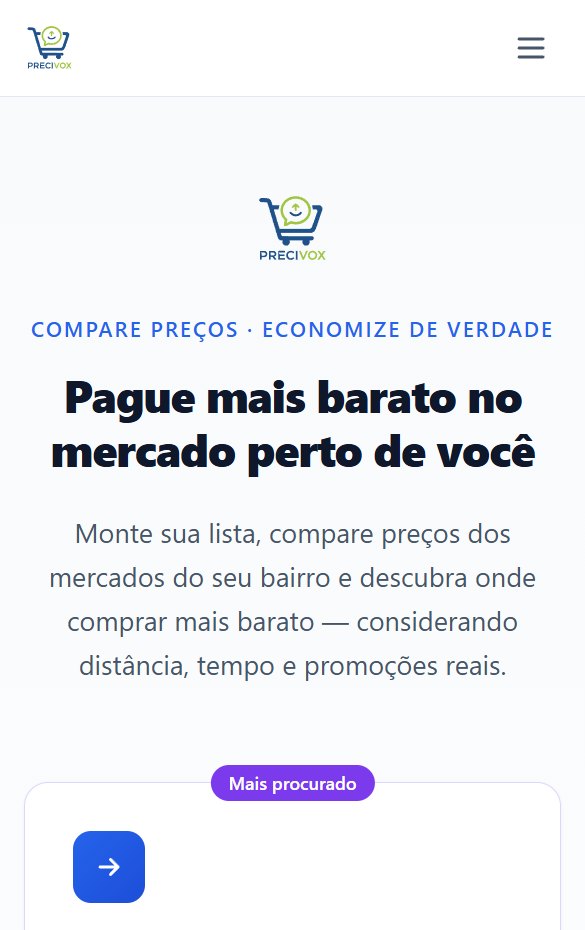
The shopper builds a list and compares neighborhood markets; a market can show up in the comparisons. AI at the core of the proposition, not as decoration.
Context
Precivox came out of the Precinho study: can user-centered design + AI make the supermarket shop stronger? Today it is a live platform for intelligent price comparison — the shopper builds a list and compares neighborhood markets; a market can show up in the comparisons.
Problem
The shelf price is rarely the real saving: distance, time, and promotions change the math. On the market side, there is no view of local demand that does not "burn margin".
My role
I was the only human in the process. I built the product end to end — discovery, design, product, and implementation — with AI as an execution partner.
Decisions
We saw that comparing price alone creates a false saving → net savings (the neighborhood context). We saw two audiences → a two-sided product. We saw that a study alone does not prove AI Builder → ship Precivox.
Solution & artifacts
Screens and project details.
A two-sided product, live
The solution is Precivox itself: intelligent price comparison in the neighborhood for the shopper, and a surface where a market can show up in the buying decision — with AI at the core of the proposition, not as decoration.
- The shopper's list → a comparison with real context (not only the shelf price).
- Local markets compete with intelligence, without "burning margin" blind.
- Shipping the Precinho study → a live product, as proof of AI Builder.
From Precinho to Precivox
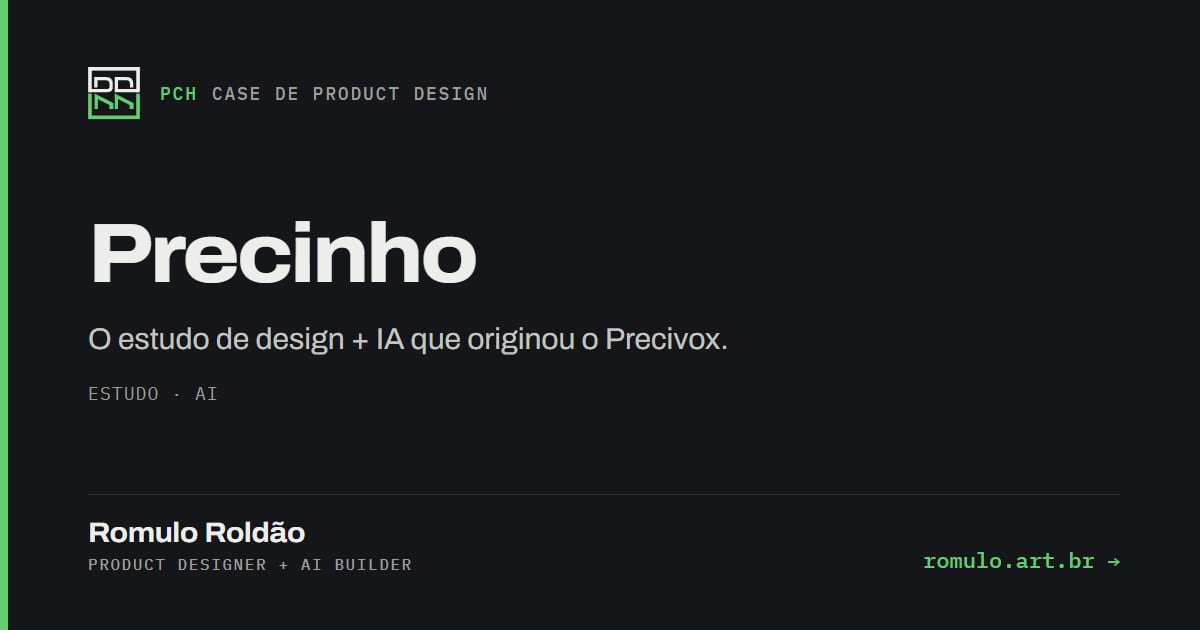
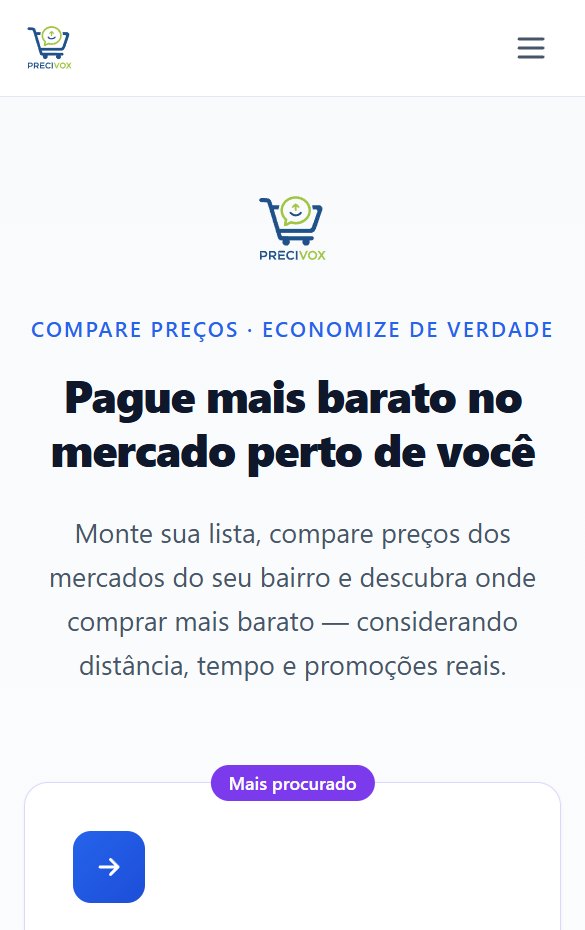
Precinho was the study: a design + AI hypothesis for supermarket shopping. It was not the final case — it was the lab. Precivox is what happened when the decision stopped being “polish the study” and became “ship the product”.
- Concept that stayed — shelf price ≠ real savings; the math needs distance, time, and promotions.
- Concept that grew — from one side (shopper) to a two-sided product (shopper + market).
- What did not come along — study-test metrics (e.g. time percentages) without revalidation on the live product.
-
Precinho (study)
- UX + AI hypothesis
- shelf-price savings
- portfolio prototype
Decision: prove the problem, not the product
-
The turn
- net savings
- two audiences
- explainable AI
Decision: a concept that can carry a product
-
Precivox (live)
- shopper + market
- AI at the core
- PRECIVOX Tecnologia Ltda.
Decision: an end-to-end product, live
What we discarded
Problem
The shelf price is rarely the real saving: distance, time, and promotions change the math. On the market side, there is no view of local demand that does not "burn margin".
Result
End-to-end product live — the only human in the process, built with AI
Impact
Impact that can be published honestly: the product itself, live (precivox.com.br), with AI at the core of the proposition — not invented business metrics.
What I learned
AI Builder is not generating a mockup from a prompt. It is being accountable for the end-to-end outcome and using AI to think, build, and put intelligence in the product.