BHS In production · coach + students · AI with limits
Black House — Coaching students with AI that guides but does not decide
The coach's back office and the student's portal on one platform: diet, workouts, a weekly check-in, and an AI agent with explicit limits.
A platform in production, used every day by the coach and by dozens of students
BHSThe platform
From the student's phone to the coach's operation.
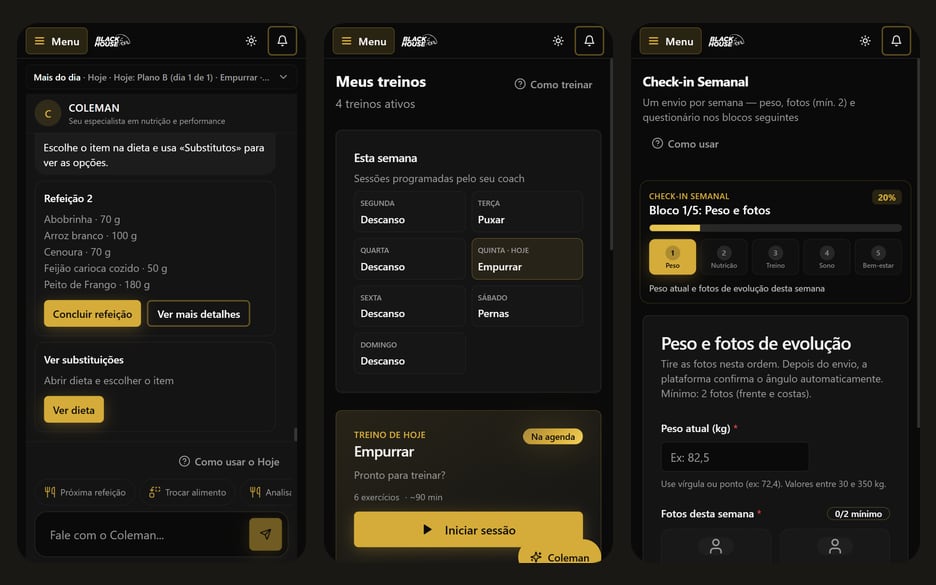
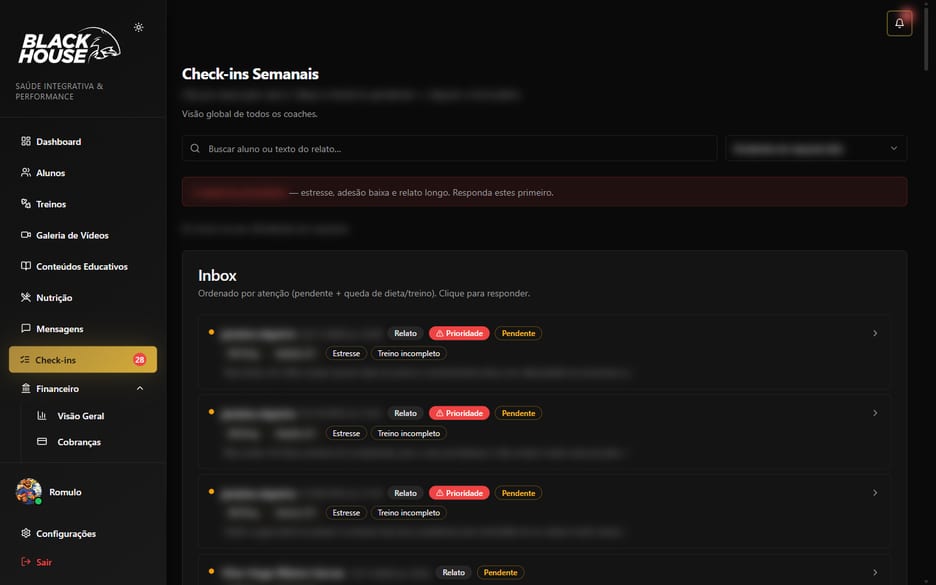
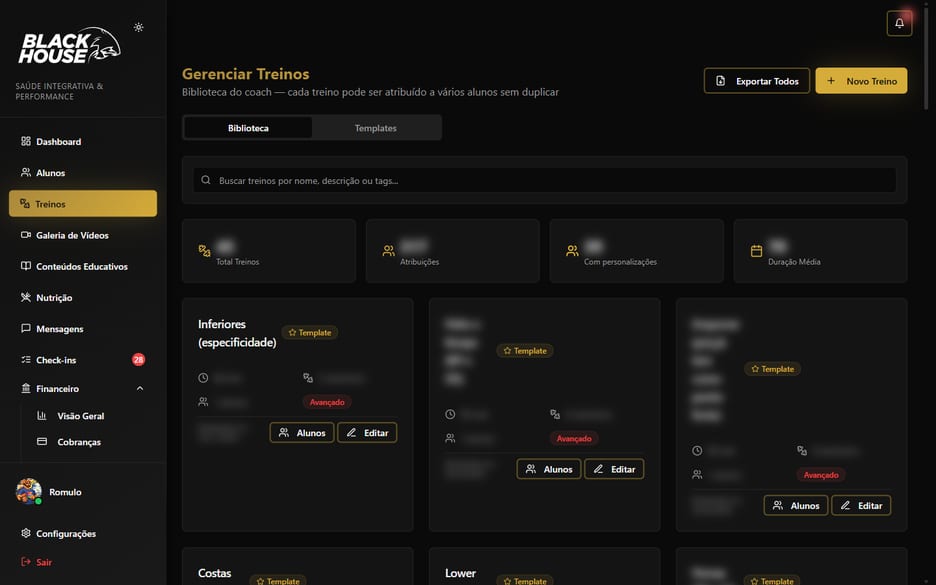
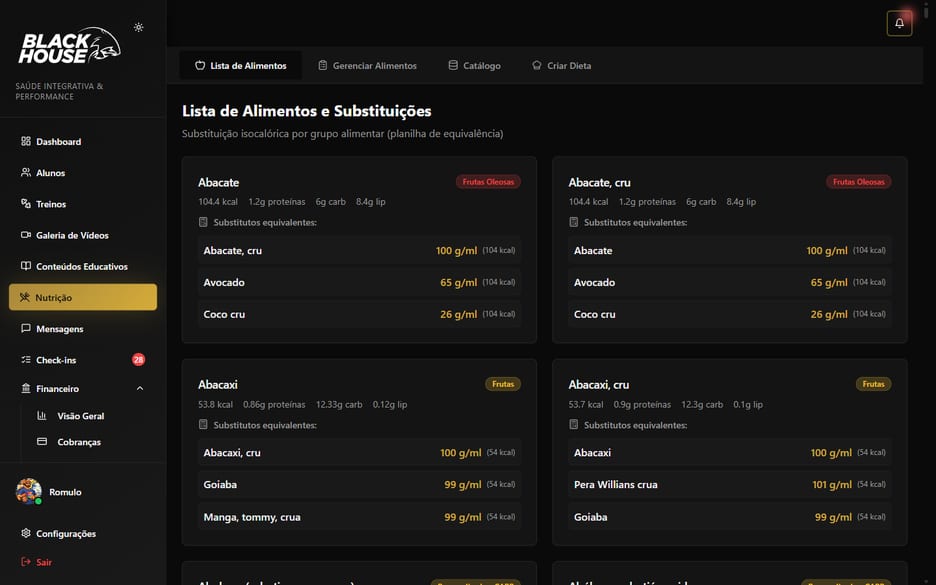
Screens in production (Nov 2026). Student names, numbers, and messages were blurred or left out.
Context
Black House is an integrative health and performance service: a coach follows each student with a meal plan, workouts on a weekly schedule, check-ins with photos and a questionnaire, messages, and billing. The platform brings both sides of that relationship together: the back office of someone running dozens of students, and the portal of someone following the plan on the phone.
Problem
Give the coach an operation that scales without losing individual care, and give the student a clear answer to "what do I do now?" — without handing to an AI health decisions that belong to the coach.
My role
Product Designer & AI Builder, end to end, for Black House: product, experience, interface, and implementation, directing AI agents in Cursor. I am also responsible for the architecture, the deploys, and the continuous evolution since October 2025.
Decisions
An agent for the student, Coleman, with autonomy levels and declared tools: it guides, suggests swaps, and takes you to the right screen, but it does not change the diet or the workout. Workout progression calculated without AI. A weekly check-in in five blocks, with a saved draft and the photo angle checked automatically. Meal-photo reading and diet PDF imports always with human confirmation. The coach's check-in inbox sorted by attention, with an AI reply draft that the coach reviews before sending.
Solution & artifacts
Screens and project details.
One relationship, two sides, one platform
The student needs to know what to do today; the coach needs to know who needs attention first. The platform answers both questions with the same data, and places AI between the two sides with a bounded role.
- Deterministic first — workout progression and access rules without an AI model.
- AI with human confirmation — meal photos, PDF imports, and check-in replies go through a person.
- Mobile for the student, desktop for the coach — each side designed for its own context of use.
Student, agent, coach
-
Student
- what do I do now?
- diet and swaps
- guided workout
- check-in in 5 blocks
Decision: a clear plan on the phone
-
Coleman (AI)
- guides and suggests
- takes you to the right screen
- does not change the diet or the workout
Decision: autonomy with a declared limit
-
Coach
- inbox sorted by attention
- reply draft, reviewed
- workouts and diets
- notices and access
Decision: an operation that scales without losing care
What we discarded
Problem
Give the coach an operation that scales without losing individual care, and give the student a clear answer to "what do I do now?" — without handing to an AI health decisions that belong to the coach.
Result
A platform in production, used every day by the coach and by dozens of students
Tensions
- AI autonomy × the coach's decision
- The student's phone × the coach's operation
- Automation × individual care
- Health data × privacy
Impact
The platform is in production: the coach plans workouts and diets, answers the weekly check-ins, and talks with students in one place; the student uses the portal on the phone. There are no published adherence or retention metrics yet. The agent on the coach's side has not been delivered yet, and billing through Asaas is integrated but not in use at the moment.
What I learned
In an AI product, the most important design decision is not what the agent does, it is what the agent cannot do — and how the person perceives that limit.