Implementing a design system on a discovery team: an experience of transformation
As a Senior Product Designer on a discovery team, I see every day the power of a design system that is well implemented. At a global technology company, where the demands are complex and the teams are multidisciplinary, a robust design system is not only an advantage — it is a necessity. But what does it actually mean to have a design system, and how can it be brought into the discovery team so that everyone gets the benefit? Below I share some of my experience and the steps I consider essential for that implementation.
A design system: much more than a component library
A design system, at its core, is a visual and functional language that standardizes how products are made, bringing consistency and efficiency to the whole team. It is much more than a simple component library. When it is well executed, the design system holds the company's design philosophy, the principles, and the guidelines that orient each visual and functional decision.
For the discovery team, that standardization is a solid starting point. It removes the need to start from zero on every new concept. That speeds up ideation and prototyping and lets the focus stay on the user's problem and the core functionality, instead of getting lost in visual details.
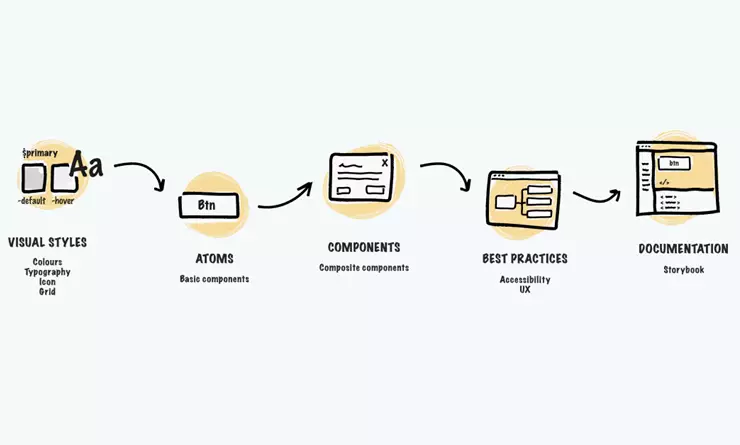
Step 1: Building awareness and alignment
When we started implementing the design system, I saw that the first crucial step was a clear understanding of its purpose and value for the whole discovery team. In a highly collaborative environment, where developers, designers, and product owners work together, everyone needs to see the design system as a tool that simplifies, not as a restriction that limits creativity.
For that, we ran a series of introductory workshops where we explored not only the visual components, but also the reason behind each decision. Those workshops were a place to exchange ideas and receive feedback, so that everyone involved understood that the design system is an adaptable resource and that it evolves with the needs of the product and the users.
Step 2: Involving the discovery team in making the design system
One of the best decisions we made was to include the discovery team in the creation of the design system. Instead of only receiving a set of predefined standards, our team was encouraged to contribute insights about the main problems faced when creating interfaces and user flows.
Each discovery session helped refine the design system, bringing up improvements and new needs. It was in that process that we saw the importance of flexible components, which could be adjusted quickly for different prototyping needs. That collaboration not only improved the quality of the components. It also created a sense of ownership on the team.
Step 3: Clear and accessible documentation
A successful design system is one that any team member can use, regardless of how familiar they are with design. We created robust documentation that went beyond showing the visual components — it explained the contexts of use, practical examples, guidelines, and even the common mistakes that should be avoided.
The documentation was meant to be a living reference, and over time we kept updating it from the team's feedback. Knowing that the discovery team could reach that source of information at any moment brought security to the process and made the onboarding of new members easier.
Step 4: Integration and use in the discovery cycle
Once the design system was in place, the final test came: using it in the day-to-day of the discovery team. To make sure it was actually useful, and not only a theoretical idea, we developed a process of direct integration between the design system and the prototyping phases.
On the discovery team, speed is crucial — and the design system brought a speed we did not have when every prototype started from zero. Instead of creating each prototype from scratch, we could use components that were already standardized, which not only sped up the validation of ideas, but also kept any solution we tested aligned with the company's visual language and standards. That modular system also let prototypes be adjusted and reused quickly as new findings appeared.
The impact of the design system on the discovery process
Introducing the design system changed how the discovery team works. It brought visual consistency, sped up ideation and, maybe most important, created a common language between designers and developers. The teams now speak the same visual and functional language, and that sharply reduced the iterations and the rework in prototyping and validation.
Today the design system has become a central piece of the discovery process, letting the team concentrate on creating value for the end user. The time that used to go into visual adjustments is now invested in understanding users' problems better and finding creative solutions. That efficiency shows up as higher quality and more agility in releases, and that is a large advantage for any company that wants to innovate with speed and consistency.
Conclusion: the design system as an engine of efficiency and innovation
Implementing a design system was not a simple process, but I can say it was one of the best decisions we made for the discovery team. Today it is the engine that lets us innovate with consistency, keeping the visual and functional quality our users expect. And more than a component library, the design system is a tool of empowerment, which makes creation easier and lowers barriers, letting the team concentrate on what actually matters: understanding and solving users' problems.